In Texas, open container laws prohibit the possession of an open alcoholic beverage container in a vehicle. Passengers can have open containers in certain areas, but drivers must not consume or possess open alcohol while driving. Violations can result in fines.
Did you know that Texas has some of the strictest open container laws in the nation? That’s right—having an open bottle of beer or wine in the passenger area of your vehicle can lead to hefty fines, even if you’re parked. For many drivers, this rule can come as a surprise, especially if they’re accustomed to more lenient laws in other states.
Understanding these open container regulations is crucial for anyone traveling in Texas. Whether you’re curious about where to store a half-finished drink or wondering about specific scenarios like drinking in a park or on a boat, knowing the rules can save you from unexpected tickets. Let’s dive into what you really need to know about open container laws in the Lone Star State.

What Is Considered an Open Container?
In Texas, open container laws are strict and specific about what constitutes an open container in a vehicle. The law defines both the items involved and the situations in which the rules apply, with a primary focus on alcoholic beverages and their storage.
Open Container Definition and Legal Standards
Texas law provides specific definitions for what constitutes an “open container” and where violations can occur. These definitions are strictly interpreted by law enforcement and courts.
| Container Type | Legal Definition | Violation Examples | Legal Exceptions | Evidence Required |
|---|---|---|---|---|
| Alcoholic Beverage Bottles | Any bottle containing alcohol with broken seal | Beer bottles, wine bottles, liquor bottles | Factory-sealed containers | Broken seal visible |
| Cans | Any aluminum/metal can with alcohol and opened | Beer cans, premixed cocktail cans | Unopened cans | Pop-top opened or punctured |
| Cups and Glasses | Any drinking vessel with alcoholic contents | Bar cups, stadium cups, wine glasses | Empty containers | Liquid present or residue |
| Flasks | Personal alcohol containers that are open | Hip flasks, decorative bottles | Sealed/closed flasks | Accessible opening |
| Mixed Drink Containers | Any container with alcoholic mixed drinks | Coffee cups with alcohol, water bottles with alcohol | Non-alcoholic beverages | Alcohol content detectable |
| Resealed Containers | Previously opened containers that were resealed | Wine bottles recorked, beer bottles recapped | Original factory seal only | Evidence of tampering |
| Partially Consumed | Containers with some contents removed | Half-empty bottles, partially consumed drinks | Full, unopened containers | Missing contents visible |
Based on search results from Texas Penal Code Section 49.031
Definition of an Open Container
An open container in Texas refers to any bottle, can, cup, or other vessel that contains any amount of an alcoholic beverage and has had its seal broken, is partially empty, or has had its seal opened. It doesn’t matter what type of drink or brand it is.
If a seal is broken—even if I try to reseal the bottle—the law still treats it as an open container. The key thing is whether the original seal was broken, not whether a lid or cap was placed on it afterwards.
Even a cup that once held alcohol is considered open under the law if there’s still a trace of liquid in it. Open containers aren’t just bottles or cans; growlers, flasks, kegs, or even disposable cups are included.
As long as it contains or has contained alcohol and is open or not fully sealed, it fits the definition.
Types of Alcoholic Beverages
The open container law in Texas applies to all types of alcoholic beverages, including beer, wine, and liquor. Beer, wine, hard liquor, and mixed drinks are all treated the same.
It doesn’t matter how strong the drink is or how much is left in the Container. Even a bottle of beer with just a sip missing, or a nearly empty bottle of whiskey, counts as an open container.
Leftover cocktails in to-go cups, alcohol in water bottles, and spiked seltzers all fall under these rules. Alcoholic beverages listed under Texas law also include products that might not seem like alcohol at first glance, like coolers, malt beverages, or ready-to-drink cocktails.
The law is broad to prevent loopholes and keep the roads safer.
Sealed vs. Open Containers
The primary concern I have is whether the seal is intact. A container with an unbroken original seal is allowed in a vehicle’s passenger area.
For example, a new, unopened six-pack of beer or a wine bottle with the cork in place is legal to transport. Once the seal has been broken, though, that Container becomes an open container.
Even if I screw the cap back on or seal it with plastic wrap, the law considers it open if the original seal has been disturbed. Resealing doesn’t change its status.
Fully sealed containers can be anywhere inside the car. Open containers must be kept out of the passenger area, usually locked in the trunk.
If I’m caught with an open container in the passenger area—even if I’m not drinking—I risk a ticket or a fine.
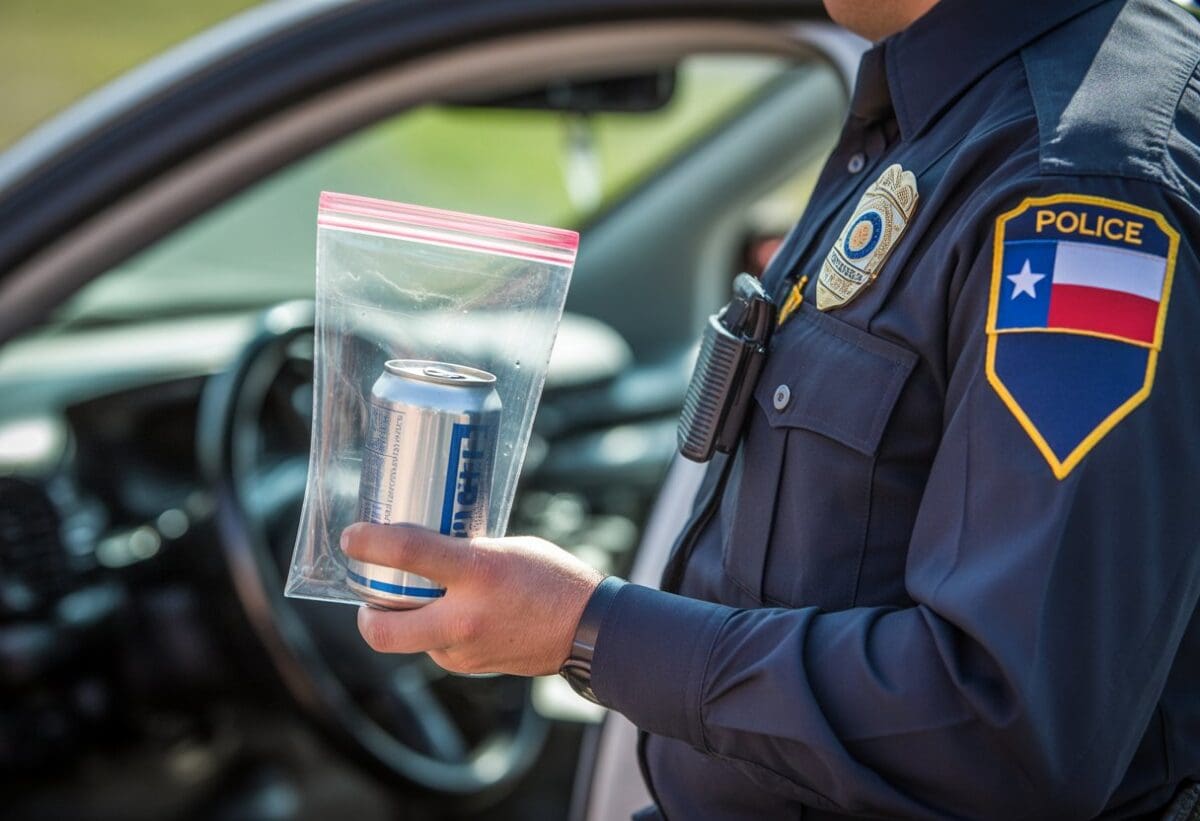
Where Open Containers Are Prohibited
Open alcoholic containers are strictly regulated in Texas. Key rules apply to where these containers may be kept in vehicles, especially while on public roads or highways.
These rules also define what constitutes public or private property.
Passenger Area Restrictions
Under Texas law, I can’t keep an open container of alcohol anywhere in the passenger area of my vehicle. The passenger area refers to any part of the car where someone can sit, including the driver’s seat, front passenger seat, or backseat.
This includes cup holders, door pockets, center consoles, and any other items within reach of anyone in the vehicle. If my truck doesn’t have a trunk, like an SUV or hatchback, Texas lets me store open alcoholic containers behind the last row of seats or in a locked glove compartment.
These rules help make sure no one in the car can easily access the alcohol while I’m on the road. This law also applies to ride-share vehicles, such as Uber and Lyft, so everyone in those vehicles must comply as well.
More details are available at Texas Open Container Law – Napier Law Firm.
Public Highways Defined
In Texas, open container rules only apply if my vehicle is on a public highway. The law defines a “public highway” as any road, street, interstate, or publicly maintained right of way.
This includes roads open for public use—even when the car is parked or stopped, not just when it’s in motion. If I’m pulled over or parked on the side of a public street, the same rules apply.
The law doesn’t apply if my car is on a private driveway or in a private parking lot, but as soon as I enter a public road, the open container rule kicks in. Each open Container constitutes a separate violation, and fines can accumulate quickly.
Learn more at Legal Awareness – Open Container Laws in Texas.
Private Properties Scope
Texas open container laws don’t apply when I’m on my own private property or private land. If I’m on my driveway, in my garage, or on other privately owned land, I’m not breaking the law by having an open alcohol container in my car.
However, once I leave private property and drive onto a public street or highway, the strict vehicle rules take effect. I need to understand this difference so I don’t accidentally commit a violation while moving from private to public areas.
For more details, visit What is the Open Container Law in Texas? Can I be Arrested?.
Exceptions to Open Container Rules
Texas open container laws are strict, but there are some important exceptions. Some locations in a vehicle and certain types of cars let you legally have open alcohol containers.
Locked Glove Compartment & Trunk
I can legally store an open container of alcohol in a locked glove compartment or the trunk of my car. The law defines the “passenger area” as anywhere inside the vehicle where people can sit, including cup holders and door pockets.
The glove compartment and trunk don’t count as part of the passenger area if they’re locked and not accessible while I’m driving. If I have an open alcohol container, I need to put it in one of these secured spots to avoid breaking the law.
Even if my car is parked, placing an open container in the passenger seat or anywhere else that’s easily accessible can lead to a ticket. Placing the Container in a locked glove box or the trunk keeps me within the law.
Special Vehicles and Living Areas
Some vehicles have their own exceptions to open container rules. If I am a passenger in a limousine, taxi, chartered bus, or motorhome, the law typically allows me to have an open container.
The rules differ because these vehicles are designed for group travel and, in some cases, feature separate areas for drivers and passengers. In a motorhome, I can have an open alcoholic beverage in the living quarters but not in the driver’s compartment.
The exemption only applies to authentic living or passenger spaces, not the front seat or areas used for driving. This allows me to enjoy a drink legally while on a road trip, as long as I stay within the vehicle’s designated living space.
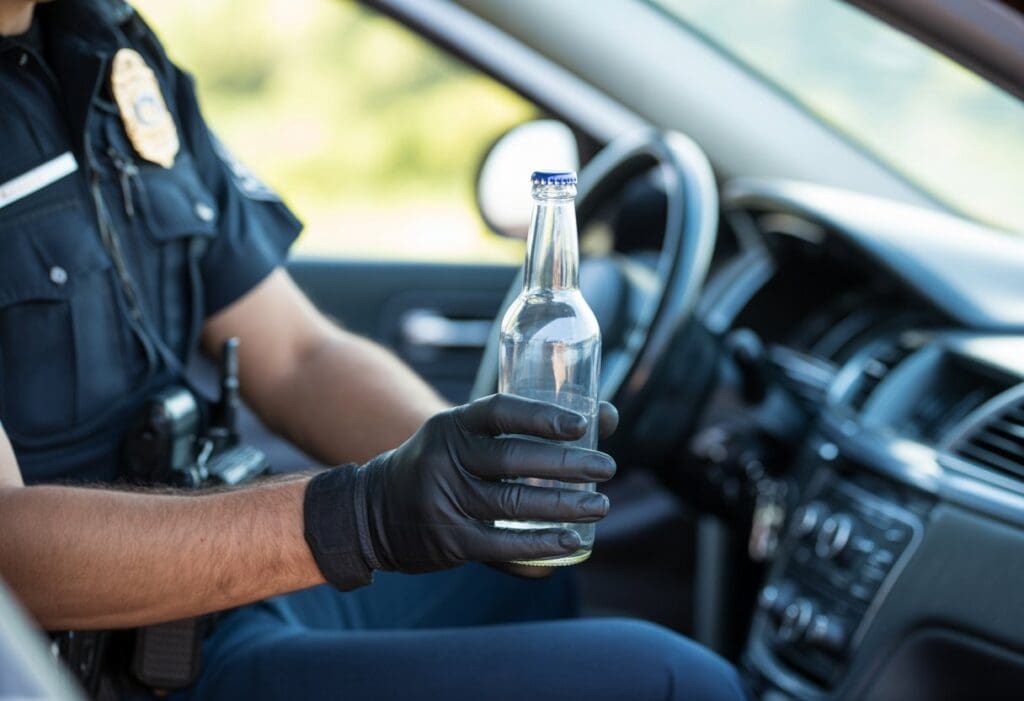
Penalties for Open Container Violations
Open container violations in Texas are taken seriously, with clear laws outlining the fines and potential criminal charges.
Repeat offenses and certain combinations with other crimes can result in even higher penalties, including possible jail time and impacts on your driving privileges.
Open Container Violation Fines
If I’m caught with an open container in the passenger area of a moving or parked vehicle on a public road, I face a Class C misdemeanor. The fine for a fundamental open container violation in Texas can be up to $500 and doesn’t include jail time for a first offense.
It doesn’t matter what type of alcohol or how much is left in the Container. Even a partially consumed beverage in an open bottle, can, or cup counts.
The law applies to both drivers and passengers, so anyone in the passenger area may be fined. However, storing open alcohol containers in the trunk or locked glove compartment is allowed.
Class B Misdemeanor Enhancements
If I’m charged with Driving While Intoxicated (DWI) and also have an open container in the vehicle, the charge jumps to a Class B misdemeanor.
For a Class B misdemeanor related to an open container with DWI, the penalty can include a fine up to $2,000 and possible jail time ranging from 6 to 180 days. The combination of alcohol in the vehicle and DWI means the court will treat the case more harshly than a simple open container violation.
In these cases, my driving record may be at risk, with a possible license suspension if convicted. This higher penalty is meant to discourage mixing drinking with driving.
Impact of Repeat Open Container Violations
If I rack up multiple open-container violations, the state can review my history during sentencing. While a single breach is typically just a fine, repeat violations or a pattern of alcohol-related offenses may result in increased penalties.
The court might decide to give me a higher fine, require community service, or require alcohol education programs. In rare cases, a pattern of repeated violations could result in increased scrutiny for related offenses.
For commercial drivers, repeat offenses have steeper consequences. I could risk losing my commercial license, along with higher insurance rates and stricter oversight.
Open Container Laws and Driving Offenses
An open container violation in Texas can land you in legal trouble, especially if you combine it with other driving offenses. There are some pretty specific rules linking open alcohol containers to DWI charges and possible impacts on my driving privileges.
Penalties and Fines for Open Container Violations
Texas open container violations carry specific penalties that can escalate quickly, especially when combined with other offenses or repeated violations.
| Violation Scenario | Classification | Fine Range | Additional Penalties | Enhanced Consequences |
|---|---|---|---|---|
| First Open Container Offense | Class C misdemeanor | Up to $500 | Court costs ($100-$200) | Permanent record |
| Open Container + DWI | Enhanced DWI penalties | $500+ DWI fines | Minimum 6 days jail | License suspension extended |
| Multiple Open Containers | Separate violations | $500 per container | Cumulative fines | Multiple court dates |
| Commercial Driver Violation | CDL implications | Up to $500 + CDL penalties | CDL suspension possible | Career impact |
| Minor with Open Container | Additional charges | $500 + minor violations | Parental notification | Educational programs |
| Public Intoxication Added | Multiple misdemeanors | Combined penalties | Possible arrest | Enhanced prosecution |
| Repeat Offenses | Pattern established | Enhanced fines | Court supervision | Habitual offender status |
Open Container and DWI
If a cop stops me while I’m driving with an open alcoholic beverage in the car and suspects me of DWI, things get a lot messier. Texas law treats an open container as an extra offense stacked on top of a DWI charge.
The law kicks in if I have an alcoholic drink with a broken seal or missing contents in the passenger area, whether my car’s moving or just parked on a public highway. Even if my blood alcohol content is under the legal limit, just having that open Container is enough for a separate charge.
I can get charged for both DWI and having an open container during the same traffic stop. This combination usually means higher fines and harsher penalties, which are spelled out in the open in Container and DWI offenses in Texas.
License Suspension Consequences
An open container ticket by itself typically does not lead to license suspension in Texas. If I get cited only for an open container and nothing else, I’m likely to face only a fine.
However, if a DWI charge accompanies that open container violation, the consequences become more severe. Now, we’re discussing the possibility of suspending my driver’s license as part of the DWI fallout.
If I’ve got prior convictions or other factors like a high blood alcohol content, the risk of suspension jumps. In such cases, my license could be suspended for a period that depends on the specifics of my case and my record.
If I refuse a breath or blood test when the police ask, I can trigger an automatic license suspension—regardless of whether I have an open Container or not. So, it’s honestly important to know my rights and the exact rules in Texas when it comes to alcohol and driving.
Relevant Texas Statutes
Texas open container laws spell out where you can keep alcohol in a vehicle and how officers should handle violations. The law also becomes quite specific about what constitutes an “open container” and where the exceptions apply.
Texas Penal Code Provisions
The primary law governing this matter is Texas Penal Code Section 49.031. It says it’s illegal for me to knowingly have an open container of alcohol in the passenger area of a motor vehicle on a public highway, even if the car isn’t moving.
If there’s more than one open Container at the same time, it still counts as just one offense for that stop. An “open container” means any bottle, can, or Container with any amount of alcohol that’s open, has a broken seal, or has some of its contents gone.
The “passenger area” refers to the seating space where the driver and passengers sit. It doesn’t include a locked glove box, the trunk, or the area behind the last seat if the vehicle doesn’t have a trunk.
Some passengers are exempt from this law. If I’m in a bus, taxi, limo, or the living area of a camper or motor home, the open container law doesn’t apply.
Enforcement Procedures
If I get caught with an open container in the passenger area of my car, that’s a Class C misdemeanor. The officer usually gives me a written citation and a notice to show up in court, not a trip to jail—assuming I sign a promise to appear.
The citation lists the time, place, and details about the charge. Once I sign, I can leave immediately. But if I refuse to cooperate, I might end up in front of a judge. It’s a pretty straightforward process, but it definitely pays to handle things at the scene.
Legal Storage Areas for Alcohol in Vehicles
Texas law permits the storage of alcohol in designated areas of a vehicle that are not part of the passenger compartment. Proper storage prevents violations.
| Storage Location | Legal Status | Requirements | Vehicle Types | Access Restrictions |
|---|---|---|---|---|
| Trunk (Sedan) | Legal storage area | Sealed containers only | Sedans, coupes | No passenger access |
| Cargo Area (SUV/Hatchback) | Legal if separated from passengers | Physical barrier required | SUVs, hatchbacks, wagons | Behind last row of seating |
| Truck Bed | Legal storage area | Weather protection recommended | Pickup trucks | Outside cab area |
| Locked Storage Compartments | Legal if inaccessible | Must be truly inaccessible | Various vehicle types | Key or combination required |
| RV Living Area | Legal with restrictions | Driver area restrictions remain | Motorhomes, RVs | Not accessible to driver |
| Commercial Vehicle Sleeper | Legal in sleeper berth | CDL regulations may apply | Semi-trucks | Separate from driver area |
| Boat/RV Towed Behind | Legal in towed vehicle | Towing vehicle rules apply | Trailers, boats | No access while driving |

Christian Linden is a seasoned writer and contributor at Texas View, local Texas resident, travel enthusiast.and author of the Home Energy Playbook. He specializes in topics that resonate with the Texan community. With over a decade of experience in journalism, Christian brings a wealth of knowledge in local politics, culture, and lifestyle. When he's not writing, Christian enjoys spending weekends traveling across Texas with his family, exploring everything from bustling cities to serene landscapes.